



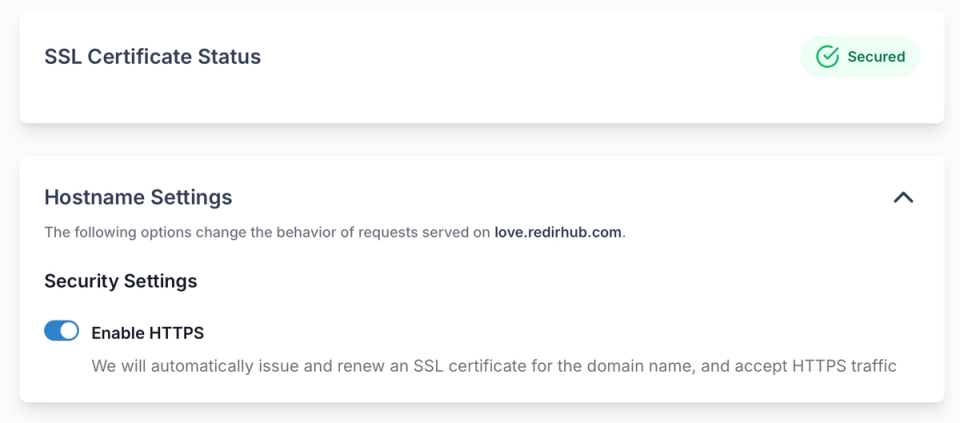
Every redirect is served over HTTPS automatically — certificates provision on first use and renew before they expire. Users never see a browser security warning.
- Auto SSL: Certificates provision automatically for every domain — no purchase, no manual setup, no renewal reminders.
- HTTPS enforcement: HTTP visitors are silently upgraded to HTTPS — no mixed content warnings, no "Connection Not Secure" errors.
- Custom certificates: Upload your own SSL certificate for enterprise, compliance, or branding requirements.
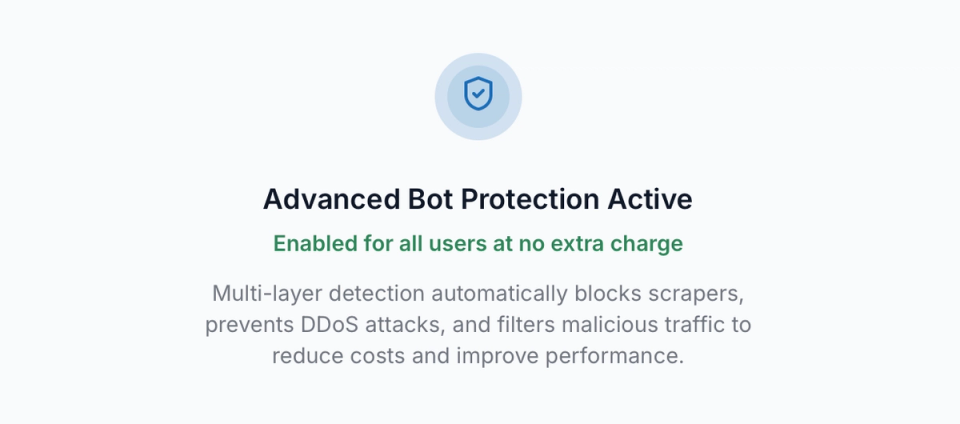
Malicious bots inflate click counts, drain request quotas, and can get your domains flagged by ad networks. Edge-level filtering stops them before they reach your redirects.
- Bot protection: Block malicious crawlers and scrapers while allowing legitimate search engine bots to pass through cleanly.
- DDoS protection: Infrastructure-level protection keeps your redirects online under distributed attack conditions — no manual response needed.
- Security plugins: Additional security layers configurable per redirect — for high-value or sensitive destination URLs.
Access logs, role-based access control, and data stored in US and EU regions — the baseline your security and compliance teams require.
- Access logs: Detailed logs of redirect activity and configuration changes — traceable when something goes wrong or needs auditing.
- Data residency: Traffic data is processed and stored in US and EU regions — no unexpected data routing outside your compliance boundary.
- Role-based access control: Only authorized team members can create or modify redirects — access is individual, traceable, and revocable.

Secure HTTPS Redirects Without Certificate Management
Serving redirects over HTTP introduces unnecessary risk: browser security warnings, broken trust signals, and measurable SEO impact from insecure or mixed-content hops. Many basic forwarding solutions rely on manual SSL configuration or fail to provision certificates automatically, exposing domains to “Connection Not Secure” errors before the redirect even completes. A secure redirect service must enforce encrypted connections from the very first request - without adding operational overhead.
Every connected domain is automatically provisioned with SSL certificates at first use and renewed before expiration. HTTPS is enforced by default at the edge layer, upgrading HTTP traffic silently and eliminating insecure intermediate hops. Redirects resolve securely and consistently across all domains, without manual certificate purchases, renewal reminders, or server-level configuration. Security becomes embedded infrastructure - not a recurring maintenance task.
Edge-Level Bot Filtering and DDoS Protection for Redirects
Redirect endpoints are frequent abuse targets. Malicious crawlers inflate analytics, exhaust request quotas, distort campaign attribution, and can trigger automated ad network penalties. Without filtering at the infrastructure level, redirect traffic data becomes unreliable and high-volume campaigns become vulnerable to automated exploitation.
Enterprise-grade redirect protection includes:
- Edge-based bot filtering that blocks malicious crawlers before they reach redirect logic
- DDoS mitigation across distributed infrastructure to maintain uptime under attack conditions
- Intelligent traffic validation that allows legitimate search engine bots to pass cleanly
- Automatic rate control to prevent abuse of high-value redirect endpoints
- Infrastructure-level protection without firewall rules or manual configuration
By filtering traffic at the edge rather than at the application layer, malicious requests are neutralized before they impact analytics, campaign performance, or redirect stability. Security enforcement happens inline with traffic routing, preserving both accuracy and availability.
Compliance-Ready Redirect Infrastructure with Full Access Control
Security also requires governance. When multiple teams manage redirects across domains, campaigns, and environments, visibility and traceability are essential to prevent unauthorized configuration changes. A secure redirect platform must provide structured access control and auditable change history aligned with enterprise security standards.
Enterprise-grade compliance capabilities include:
- Detailed access logs recording redirect edits, creations, deletions, and configuration updates
- Role-based access control (RBAC) to restrict permissions by domain, role, or responsibility
- Individual user authentication with full traceability - no shared credentials
- Data residency across US and EU regions to support regulatory alignment
- Immediate access revocation to support secure offboarding and incident response
With full audit visibility and granular permission management, redirect infrastructure becomes accountable and compliance-aligned. Teams can validate configuration integrity, investigate changes quickly, and maintain operational control without slowing execution.
Infrastructure-Level Security Designed for High-Trust Environments
Redirect infrastructure operates as a foundational routing layer for SEO migrations, campaign traffic, product launches, and domain consolidation. Any disruption at this layer can break attribution chains, weaken ranking continuity, or expose users to insecure routing paths. Security failures in redirect infrastructure are not cosmetic - they have measurable business impact.
This platform is engineered with distributed edge architecture, automated SSL lifecycle management, continuous health monitoring, and real-time attack mitigation. Multi-region redundancy and automatic failover maintain redirect resolution even during infrastructure disruption or traffic anomalies. Security controls are applied consistently across domains and traffic volumes, ensuring encrypted delivery, protected endpoints, and resilient uptime under both normal and adverse conditions.
Deploy secure URL redirects with enforced HTTPS, edge-level bot filtering, DDoS protection, and compliance-ready access control - all managed from a centralized platform designed for performance, governance, and operational reliability.
Why Our Customers Love RedirHub

I enjoy using Redirhub for its useful tools that help with my promotions. Its customer service efficiently helped me with my work. I highly recommend this company for your needs.

Easy to configure tool that does what it promises. Needed something simple to redirect from one URL to another and this was by far the easiest option I found.


Frequently asked questions